
Playing through with Blackjack
Blackjack is a card game where you try to finish closer to 21 than the dealer without going over. Your decisions matter, so use a strategy chart instead of playing by instinct.
Why use it for playthrough
With player-friendly rules and correct basic strategy, Blackjack is usually one of the stronger-return table-game choices. It is manual, though: mistakes and side bets can erase that advantage quickly.
Before you start
Use the smallest workable SC bet. Prefer a game that pays Blackjack 3:2, lets you double after splitting, and has no side bet requirement. A dealer standing on soft 17 is generally preferable, but the chart below is for the common H17 version.
Do not take insurance or even money. If you bought SC at a discount, choose the game rules and bet size before playing so the playthrough cost does not undo the offer's value. If the rules differ materially, use that game's own strategy help instead of forcing this chart onto it.
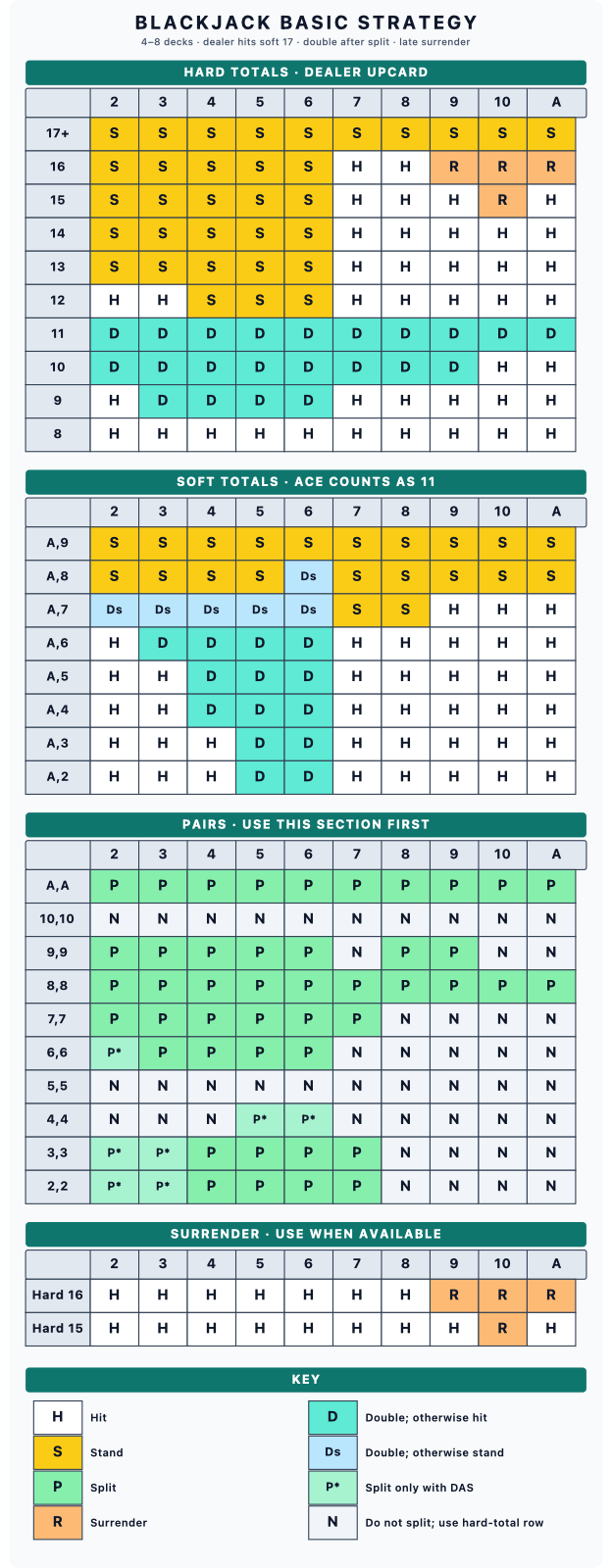
Basic strategy chart
This chart assumes 4-8 decks, dealer hits soft 17, doubling after splitting, and late surrender. Find your hand on the left, then the dealer's upcard across the top. If the game's rules differ, use its own chart.
Expected retention
With suitable rules and accurate basic strategy, Blackjack is generally in the high-99% RTP range over very many hands. A short session can finish far above or below that; the actual rules decide the exact rate.
Time and pace
Standard Blackjack is slower because every hand needs a decision. Multi-hand Blackjack moves playthrough faster, but only use it once the chart feels automatic: more hands also put more SC at risk at the same time. Live Blackjack is slower still and gives less time to learn at your own pace.
Use GC first until the chart and controls feel familiar. Then keep the bet low, follow the same chart every hand, and stop when the required playthrough is complete.